Design System Maturity: 5 Levels Explained
Design system maturity spans five levels - from UI Kit to Public System. Learn your stage, read the signals, and pick the right next step.
Design system maturity describes how far a team has moved from a static Figma UI kit to a governed, cross-discipline platform. Most teams sit at Level 2 or early Level 3 - they have components and a shared library, but lack the governance, tokens, and multi-team processes that define a real design system. Knowing your level replaces vague roadmap anxiety with a concrete next step. This guide covers all five levels, how to recognize each one, and what to prioritize at each stage.
What design system maturity means
Design system maturity is a structured way to assess where your system stands across five dimensions: documentation, governance, tooling, team structure, and adoption. A mature design system is not just a large Figma library - it is a shared infrastructure that connects design decisions to production code, spans multiple products, and has named ownership. The five-level model maps that progression from a single UI file to an externally-facing platform. For teams trying to understand what a design system actually is before assessing maturity, that broader definition is a useful starting point.
The 5 maturity levels at a glance
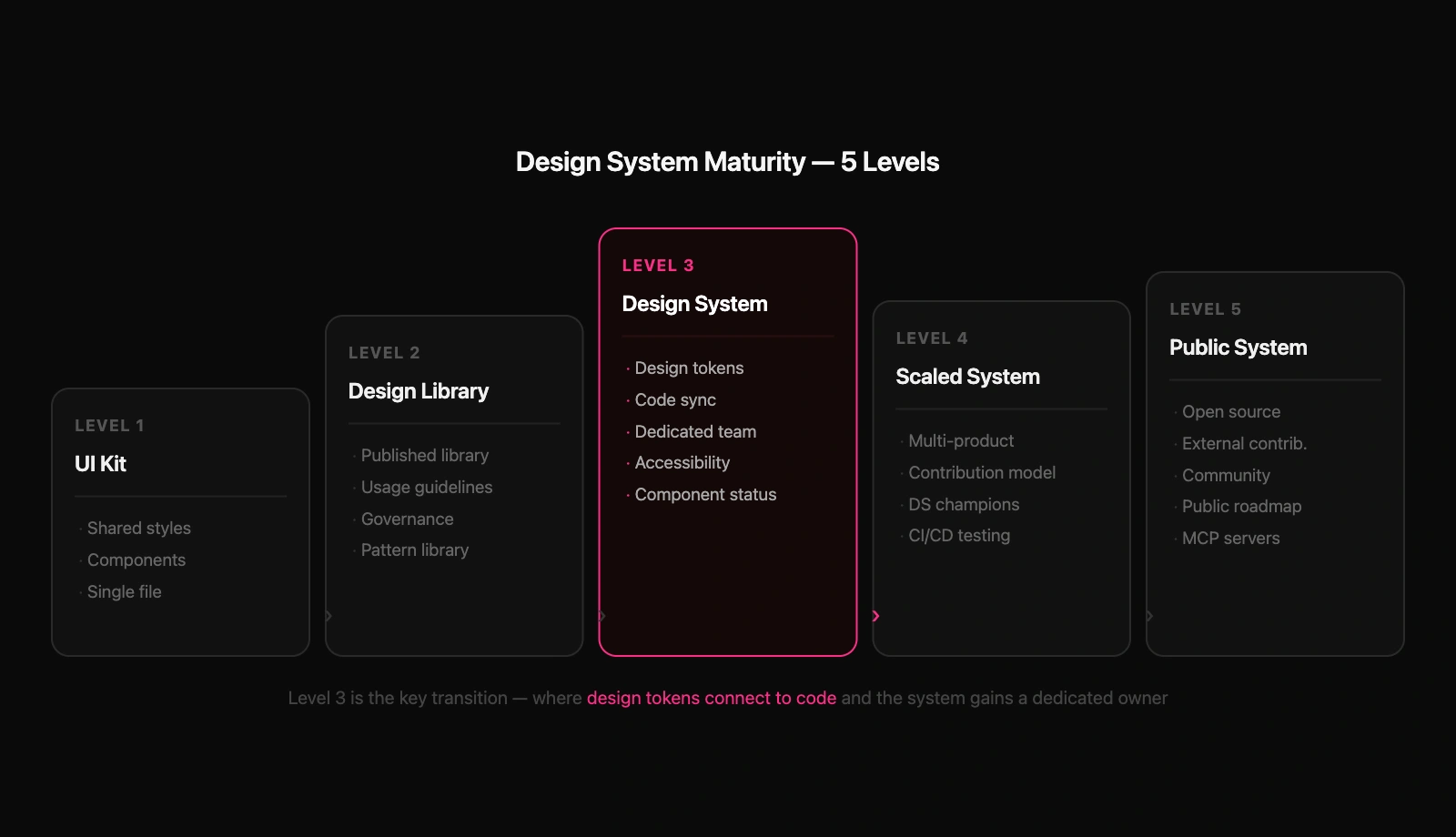
Design system maturity levels
| Level | Name | Core characteristic | Key missing piece |
|---|---|---|---|
| 1 | UI Kit | Shared Figma styles and components | No governance or process |
| 2 | Design Library | Published library with usage guidelines | No code connection, no dedicated owner |
| 3 | Design System | Tokens, code sync, cross-discipline team | No multi-product support |
| 4 | Scaled System | Multi-product, contribution model, CI/CD | No external visibility or community |
| 5 | Public System | Open-source or industry-facing platform | — |
Levels 1 and 2: Early stages
At Level 1, the system is a single Figma file - a UI kit. It provides a shared reference for colors, text styles, and components, which is enough for a solo designer or a small team working on one product. There is no formal governance, no expectation that anyone maintains it, and no documented process for contribution. Most startups begin here, and that is appropriate for the stage.
Level 2 emerges when a team publishes the Figma library and wraps process around it. Usage guidelines, naming conventions, and a pattern library appear. Someone - even part-time - is responsible for reviewing updates and communicating changes to consumers. This is when design system thinking actually starts. Without basic governance practices, a library stays at Level 1 regardless of how many components it contains.
- Level 1 signals: single file, no published library, components duplicated across projects, no named maintainer
- Level 2 signals: shared Figma library published across teams, component contribution process exists, someone reviews updates before publishing
- Common mistake: growing the component count without establishing governance first - more components in a Level 1 system does not advance maturity
Level 3: The real design system
Level 3 is the most significant transition - the point where a design system earns its name. What separates Level 3 from a well-maintained library is that multiple disciplines connect into one system: design, engineering, content, and accessibility all operate from a shared source of truth. A dedicated design system role or small team exists. Most importantly, design tokens replace raw Figma styles and are consumed directly in code.
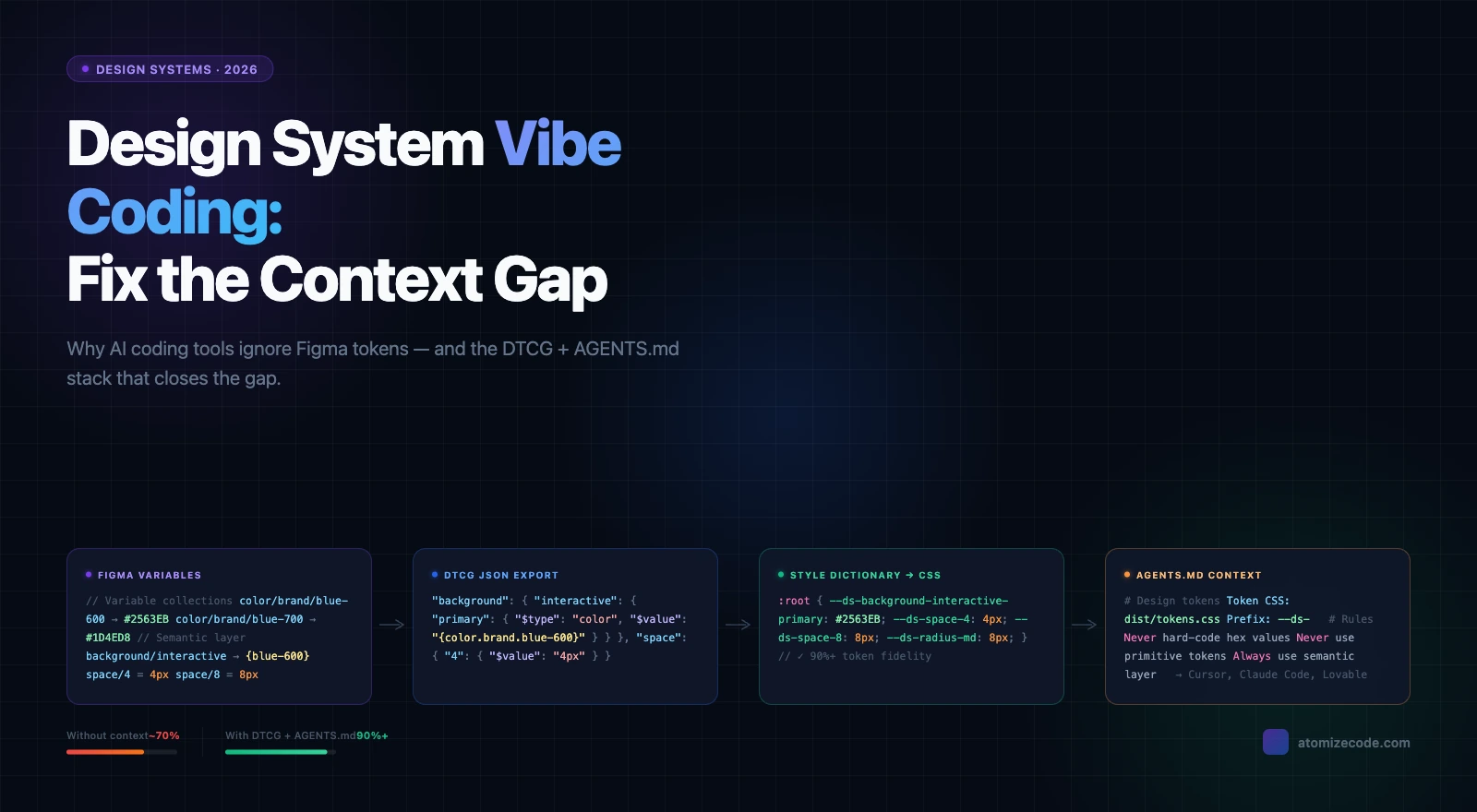
Tokens are the clearest technical signal of Level 3 maturity. Where a Level 2 library uses local Figma styles with raw values, a Level 3 system adds a semantic layer aligned with the W3C Design Tokens Community Group specification - so decisions like 'interactive background color' are expressed once and referenced everywhere, in Figma via Variables and in code via a pipeline like Style Dictionary.
In Atomize's token scans, files that self-identified as Level 2 or early Level 3 showed one pattern with near-perfect consistency: a Primitives collection existed, but components were bound directly to blue/600 instead of interactive/default. That single binding decision is the most reliable technical signal that a library has not crossed into Level 3 — it means the semantic layer, and everything that depends on it (dark mode, theming, a clean CSS export), does not yet exist.
- Dedicated design system owner or team
- Design tokens with a semantic naming layer connected to Figma Variables
- Code sync: tokens exported to a shared repository consumed by engineers
- Accessibility built in at the component level, not audited after the fact
- Component status page (stable, beta, deprecated)
- Regular office hours or design system reviews with consuming product teams
- Release notes and a shared vocabulary across design and engineering
Levels 4 and 5: Scaling and going public
Level 4 systems support multiple products from a single source. This requires a contribution model - a documented process for product teams to propose, build, and merge components back into the system. Design system champions inside product teams handle day-to-day questions, reducing load on the core team. Advanced theming, a living roadmap, visual regression testing, and automated CI/CD pipelines are standard here. Organizations like Atlassian and Shopify operate at Level 4 or above.
Level 5 is reserved for systems that influence the industry rather than just their own products. These are open-source or publicly documented platforms - Material Design is one example - that accept external contributions, publish research, and often provide community resources or certification programs. Most product companies will never need Level 5, and pursuing it prematurely consumes resources that should go toward solidifying Level 3.
How to self-assess your maturity level
The most reliable way to assess your level is to run a team vote on specific checkpoints. Because team members often hold different mental models of what the system covers, the discussion itself surfaces alignment gaps as valuable as the final score. Use these five questions as a quick diagnostic - each 'no' signals your actual ceiling.
- Is your Figma library published and actively used by teams other than the one that built it?
- Do you have documented usage guidelines and a review process for adding new components?
- Are design tokens defined with a semantic layer and consumed in production code?
- Is there a named owner or dedicated team responsible for the design system?
- Does the system support more than one product without a separate fork?
A 'yes' to questions 1-2 but 'no' to 3-5 places you at Level 2. A 'yes' to all five is a strong Level 3. If question 3 is uncertain, read the Figma design tokens guide before deciding. For teams starting this transition, building the system step by step covers the scaffolding in order.
What to prioritize at each stage
What to build next at each maturity level
| Current level | Highest-value next step | What to avoid |
|---|---|---|
| Level 1 | Publish the library and write basic usage guidelines | Adding more components before governance exists |
| Level 2 | Introduce design tokens and establish a code sync process | Jumping to CI/CD or contribution models |
| Level 3 | Add multi-product support and a formal contribution model | Building advanced theming before adoption is stable |
| Level 4 | Evaluate whether public documentation creates strategic value | Open-sourcing before internal processes are solid |
One of the most common mistakes at Level 2 is trying to reach Level 4 directly - adding automation and governance frameworks before the token and code sync layer exists. The token layer, and the design-to-code parity it enables, is the foundation everything above Level 3 depends on. Without it, contribution models and CI/CD pipelines rest on an unstable base.
Final verdict - Design System Maturity
Most product teams should aim for a solid Level 3: tokens connected to code, a dedicated owner, and accessibility built in from the start. Level 4 is the right goal for organizations running multiple products with enough team bandwidth to support a contribution model. Level 5 is a strategic decision, not a quality signal. Know your level, pick the right next step, and resist the pull to skip foundations.
Design system maturity is a five-level model that describes how far a design system has evolved - from a basic UI kit to a multi-product, cross-discipline platform. Each level adds governance, tooling, team structure, and adoption depth. Knowing your level gives teams a concrete framework for deciding what to build next instead of guessing at priorities.
A design library is a shared Figma file with published components and styles (Level 2). A design system adds design tokens, code sync, cross-discipline ownership, and documentation that connects design decisions directly to engineering output (Level 3). The key distinction is whether design decisions are consumed in production code - if not, you have a library, not a system.
Answer five questions: Is the library published and used by multiple teams? Are there usage guidelines and a review process? Are design tokens connected to production code? Is there a dedicated owner? Does it support more than one product? Two 'yes' answers is Level 2. Five 'yes' answers is a strong Level 3. The hardest gap is the token-to-code connection.
Most product companies do not need a Level 5 design system. Level 5 - open-source platforms with external contributions and public research - requires sustained team investment and is worthwhile only when industry influence is a deliberate strategic goal. For most teams, a well-governed Level 3 or Level 4 system delivers more value per dollar of investment.
The Level 2 to Level 3 transition is the most consequential. This is when design tokens are introduced, code sync is established, and a dedicated owner takes responsibility for the system. Without these three elements, the library stays a design-only artifact that engineering teams cannot reliably consume. Most design system failures stem from skipping this transition.
Moving from Level 1 to Level 2 takes 1-3 months for a small team with existing components. The Level 2 to Level 3 transition typically takes 3-9 months because it requires token architecture, code pipeline setup, and engineering alignment. Level 4 maturity usually needs at least a year of stable Level 3 operation before multi-product expansion is practical.
Yes. Team size does not determine maturity - process and infrastructure do. A two-person design team can operate at Level 3 if they have tokens connected to code, documented guidelines, and a review process. Larger teams often run less mature systems because governance lags behind component growth. Maturity is about infrastructure quality, not headcount.